
Designing With a Ghost: When AI Becomes Your Creative Director
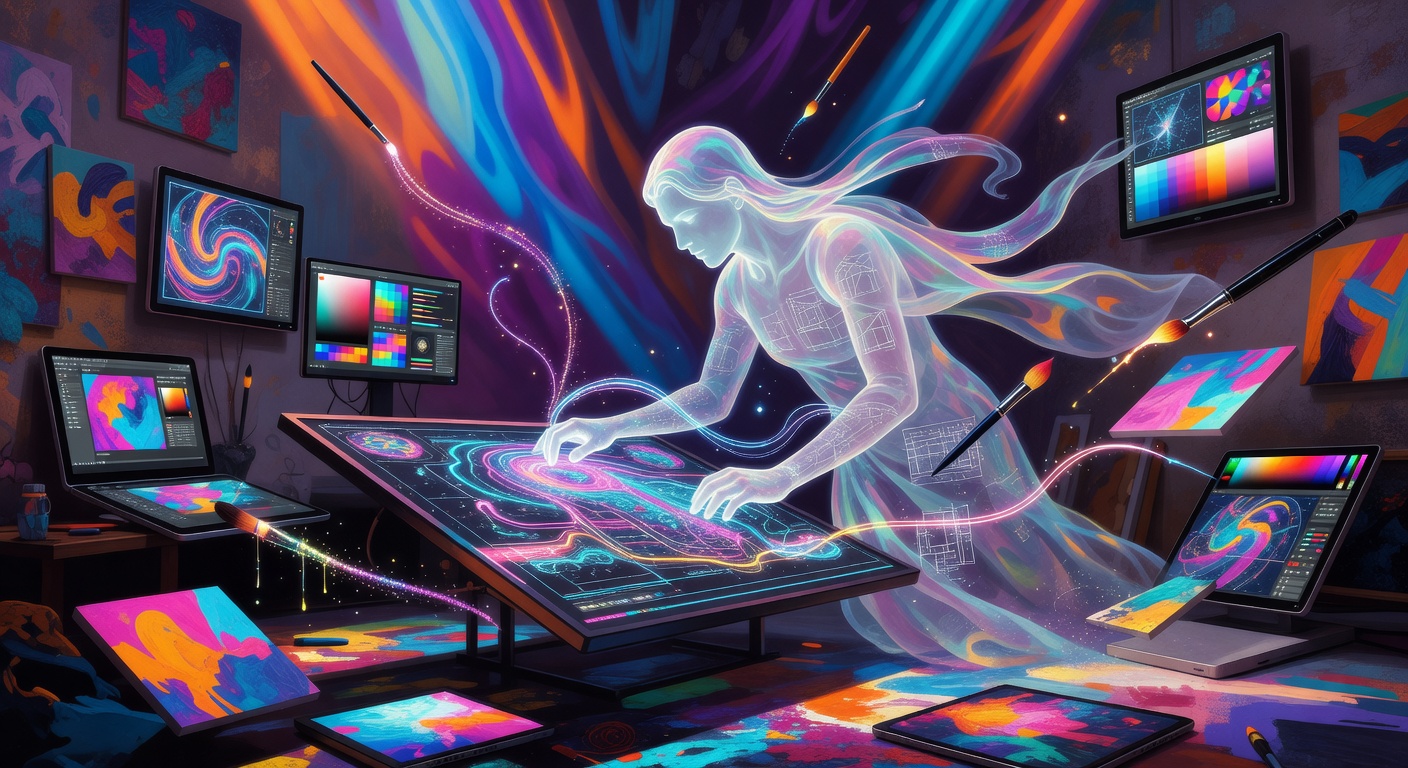 AI-Generated ImageAI-Generated Image
 Design has always been a conversation between constraint and creativity — the tension between what is possible and what is beautiful, between function and form, between the brief and the breakthrough. Adding AI to this conversation introduces a new kind of creative partner — one that processes visual information differently than any human mind, that generates options without attachment, and that can iterate at a speed that fundamentally changes the design process.
Working with AI as a design partner is unlike working with a human collaborator. A human designer brings experience, emotion, cultural awareness, and the ability to understand unspoken expectations. An AI design partner brings pattern recognition across millions of visual examples, tireless variation generation, and freedom from the cognitive biases that both help and hinder human designers. The combination, when managed well, produces design work that neither partner could achieve independently.
The AI Design Workflow
The most effective AI-assisted design workflows do not start with AI. They start with human thinking — defining the problem, understanding the audience, establishing the constraints, and articulating the creative direction. AI enters the process after the strategic foundation is in place, serving as an accelerator for exploration and execution rather than a substitute for strategic thinking.
In the exploration phase, AI excels at generating a breadth of options that would be impossible to produce manually in the same timeframe. A brand identity exploration that might yield a dozen concepts in a traditional brainstorming session can generate hundreds of AI-assisted variations. Mood boards can be populated with AI-generated imagery that captures specific emotional tones. Color palettes, typography pairings, and layout compositions can be explored systematically, with AI generating combinations that a human designer might not have considered.
The human designer’s role in this process is curatorial and directional — evaluating the AI’s output, identifying promising directions, providing feedback that refines subsequent generations, and applying the contextual understanding that AI lacks. The AI does not know that the client has an aversion to blue, that the industry has a visual convention that should be respected or deliberately broken, or that the target audience associates certain visual styles with specific values. The human holds this knowledge and uses it to guide the AI’s output toward relevance.
Brand Identity Development
Brand identity design is a particularly interesting application of AI because it requires both visual creativity and strategic coherence. A brand identity is not a collection of pretty pictures — it is a visual system that communicates specific values, appeals to a defined audience, and differentiates from competitors. Every element must work together and must work in context.
AI tools can generate logo concepts, but evaluating those concepts requires understanding that extends far beyond visual appeal. Will the logo work at small sizes? Is it distinctive enough to be recognizable? Does it communicate the right personality? Can it be reproduced across different media? These questions require design expertise that AI does not possess, making brand identity a domain where human-AI collaboration is essential rather than optional.
The most successful approach treats AI-generated concepts as starting points for development rather than finished products. A generated logo concept might capture an interesting visual direction that a human designer then refines, simplifies, and adapts for production. The AI provided the spark; the designer provided the craft.
UI and Digital Design
User interface design has been transformed by AI tools that can generate layouts, component designs, and interaction patterns from descriptions or wireframes. The speed of AI-generated UI design enables rapid prototyping — testing multiple approaches to a screen layout, comparing different navigation patterns, and evaluating visual hierarchies before committing to a direction.
Design system management benefits from AI’s ability to ensure consistency across large collections of components. AI can identify inconsistencies in spacing, color usage, and typography across a design system, suggest corrections, and generate new components that adhere to established patterns. For organizations maintaining design systems across multiple products and platforms, this automated consistency checking is enormously valuable.
Print, Packaging, and Environmental Design
AI’s impact extends beyond digital design into physical design disciplines. Packaging design benefits from AI’s ability to generate and evaluate many visual options quickly, while also providing tools for mockup generation that show how a design will look on a physical product. Print layout automation handles the tedious aspects of document design — text flow, image placement, grid alignment — freeing designers to focus on the creative decisions that make each piece distinctive.
Environmental and spatial design applications are emerging, with AI tools that can generate interior design concepts, wayfinding systems, and spatial branding applications. The ability to visualize a design concept in context — seeing how a brand identity system looks applied to a physical space — accelerates decision-making and reduces the risk of designs that look great on screen but fail in reality.
The Creative Director Question
Can AI be a creative director? The answer depends on what you mean by creative direction. If creative direction means generating visual ideas, AI can do this prolifically. If it means selecting among options based on strategic criteria, AI can do this with guidance. But if creative direction means understanding the human context of a design problem — the culture, the emotions, the unspoken expectations, the political dynamics of a client relationship — then creative direction remains fundamentally human.
The most productive framing is not AI as creative director but AI as the most capable design assistant ever created — one that never tires, never runs out of ideas, and executes with perfect consistency. The creative direction comes from the human who understands why the design matters and who it is for. The AI provides the how, at a speed and scale that transforms what is possible.
This category at Output.GURU is where design thinking meets artificial intelligence. We will explore workflows, tools, and case studies that demonstrate the potential of human-AI design collaboration. The ghost in the machine has opinions about composition, color, and form. Learning to work with those opinions — directing them, challenging them, and building on them — is the design skill of the present and the future.